Complete guide
French drains
A French drain is a gravel-filled trench with a perforated pipe in the bottom. That is the whole invention. What changes between a soggy lawn and a wet basement is not the drain — it is the depth, the outlet, and what happens if you get it wrong.
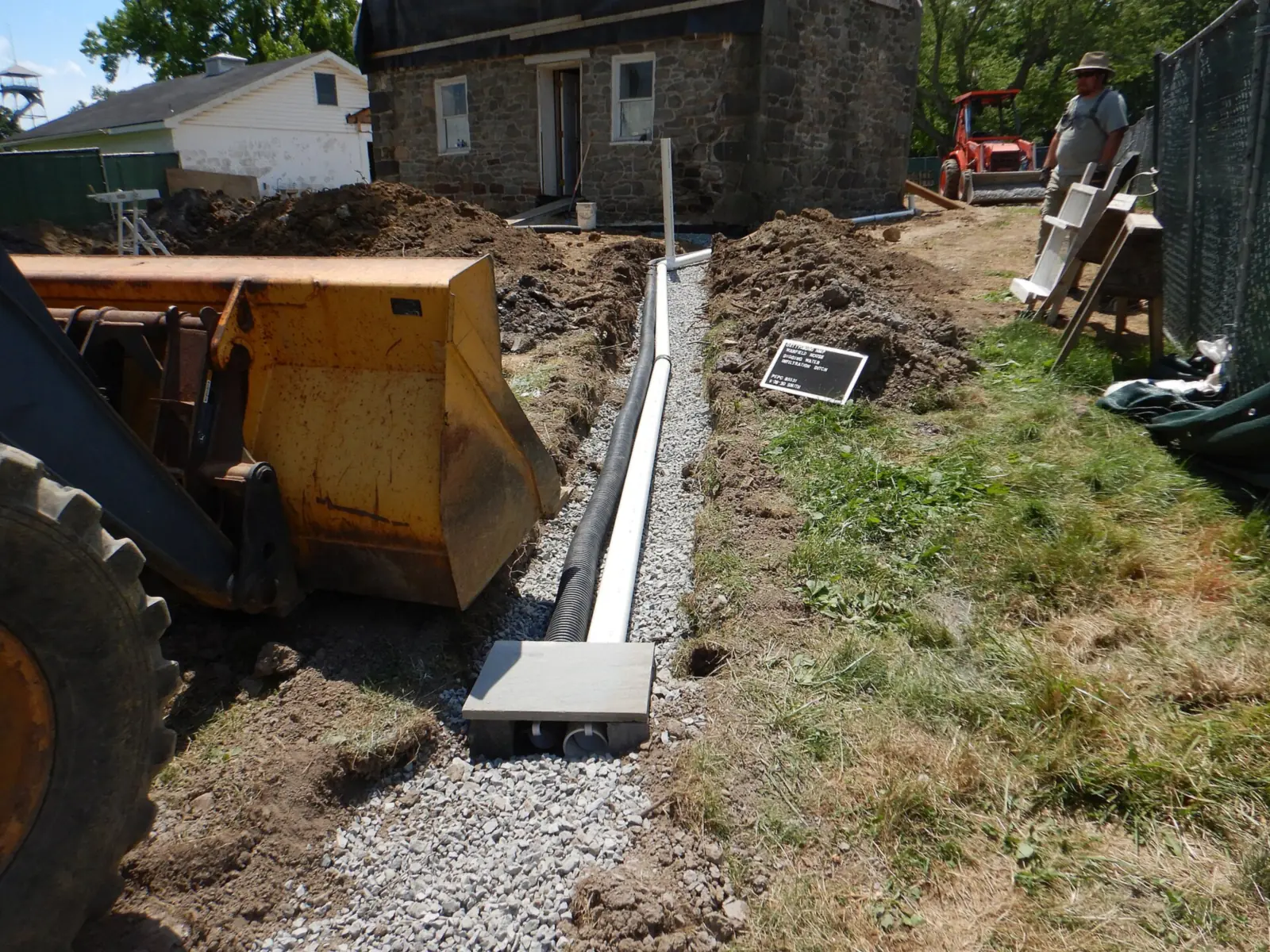
This page covers all three placements: in a yard, around a foundation from outside, and inside a basement along the footing. They are the same trench doing three different jobs, and the reason people end up searching for the third one is usually that nobody did the first two.
On this page
Where the water goes
Every drainage decision on a residential lot is one question asked three times: what happens to the rain that lands here? There are only three answers, and they run in order.
Soak it in
Infiltration at the source. A rain garden or dry well takes roof water out of the system entirely. Cheapest option, and the only one that reduces total volume rather than moving it.
Carry it away
What will not soak in has to travel. This is the French drain's job — intercept subsurface and surface water and move it somewhere it can leave.
Keep it out
When water reaches the footing anyway, the work moves below grade and gets expensive. Foundation and basement water is the failure mode of the first two steps.
Homeowners almost always enter this at step three, because step three is the one that ruins a carpet. The cheapest fix is usually one step back up the chain.
How a French drain works
Water in soil moves toward the path of least resistance. A trench backfilled with clean, open-graded gravel is a far easier path than compacted soil, so water in the surrounding ground migrates into the trench. Once there, gravity carries it along the slope of the trench to a perforated pipe at the bottom, and the pipe carries it out.
Two consequences follow from that, and they explain most French drain failures. The trench only works while the gravel stays open — fill the voids with silt and it becomes a buried lump of dirt. And the drain only works while it has somewhere to go — a pipe that outlets nowhere is a trench that fills up and stays full.
Yard French drains
The standard residential case: a soggy patch, a low spot that holds water for days, a lawn that will not dry out. The drain runs from the wet area to a lower outlet, at a shallow depth, and intercepts water moving through the topsoil.
| Typical depth | 18–24 in |
|---|---|
| Trench width | 12–18 in |
| Slope | Minimum 1%, meaning 1 ft of fall per 100 ft of run |
| Outlet | Daylight on a downslope, or a dry well |
| Cost | $20–$40 per linear foot installed — estimate yours |
Before digging a yard drain, check whether the water is arriving from a downspout. Rerouting one downspout costs almost nothing and solves a surprising share of "I need a French drain" problems outright.
Exterior foundation drains
Also called a footing drain or a perimeter drain. It sits at the base of the foundation wall, at footing depth, and intercepts groundwater before it reaches the wall. On new construction this is standard. Retrofitting it means excavating the full depth of the foundation around the house.
| Typical depth | Footing level — commonly 6–8 ft |
|---|---|
| Also involves | Exterior waterproof membrane, often replaced while the trench is open |
| Disruption | Landscaping, walkways, decks and patios in the excavation path |
| Cost | $60–$120 per linear foot — the most expensive drain on this page |
It is the most thorough fix available because it stops water before it touches the structure. It is also the one where the quote arrives and homeowners start asking whether the interior version would do.
Interior basement drains
A channel cut into the basement slab at the perimeter, with pipe laid beside the footing and routed to a sump pit. It does not stop water reaching the wall — it collects what gets through and pumps it out.
| Typical depth | Below slab, beside the footing |
|---|---|
| Requires | A sump pit and pump, and usually a backup pump |
| Advantage | No excavation, no landscape damage, works in winter |
| Cost | $50–$95 per linear foot, plus $1,000–$3,000 for the sump system |
Exterior treats the cause; interior manages the symptom. Interior is cheaper, faster, less disruptive, and dependent on a pump that will eventually fail — which is why a battery backup is not an upsell.
How deep should a French drain be?
Deep enough to sit below the water you are trying to intercept, and shallow enough to still fall toward its outlet. For a yard drain that is usually 18–24 inches. For a footing drain it is whatever depth the footing is. What matters more than the number is that the trench bottom slopes continuously — a drain with a dip in it holds water at the dip permanently.
Pipe, gravel and fabric
Pipe. Rigid perforated PVC over corrugated flexible pipe wherever you can afford it. Rigid holds its slope, resists crushing, and can be cleaned out with a snake. Corrugated pipe sags between supports and its ridges catch sediment.
Holes down. Counterintuitive and correct. Water enters from the surrounding gravel at the bottom of the trench first, and holes down lets the pipe start carrying water at a lower level.
Gravel. Clean, washed, angular, 3/4 in. Not pea gravel, not crusher run with fines in it. The voids between stones are the storage and the flow path; anything that fills them is the enemy.
Fabric. Non-woven geotextile lining the trench, wrapped around the gravel, not just around the pipe. Its job is keeping soil fines out of the gravel. A sock on the pipe alone leaves the gravel to silt up, which is the failure that takes five years to show up.
Where does it actually drain to?
The single most skipped decision. Options, in order of preference:
- Daylight. The pipe emerges on a downslope and water runs out. Free, passive, nothing to fail. Requires the fall to exist.
- Dry well. A buried gravel or chambered reservoir that holds water and lets it infiltrate. Works where there is no fall and the soil drains. $1,500–$4,000.
- Sump pump. Mechanical, needs power, will fail eventually. Mandatory for interior systems.
- Storm sewer. Where legal. Many jurisdictions prohibit it, and connecting to a sanitary sewer is illegal essentially everywhere.
A drain with no outlet is a trench that fills with water and holds it against whatever it was supposed to protect.
What it costs
Range across all three placements runs from about $1,000 for a short yard run to $15,000-plus for exterior foundation work on a full perimeter. The variables that move the number most are depth, access for machinery, and what the outlet ends up being.
Seven ways French drains fail
- No outlet. The trench fills and stays full.
- Insufficient or reversed slope. Water pools at the low point instead of travelling.
- Dirty gravel. Fines fill the voids and flow stops.
- Fabric around the pipe only. Protects the pipe, abandons the gravel.
- Corrugated pipe in a long run. Sags, holds water, cannot be cleaned.
- Too shallow for the water table. The drain sits above the problem.
- Treating a downspout problem with a trench. Expensive answer to a $40 question.
Before you dig anything: call 811 for utility locates. It is free, required in most states, and hitting a gas line at 24 inches is exactly the depth a French drain gets you to.